

Bilateral Breast
Gallery: Bilateral Breast (8 PTVs)
Summary
This is the dataset used in a 2019 Plan Study run by the University of Calgary and publicly available via the ProKnow Quality Systems website.
This dataset and treatment plan design is to study the dosimetric possibilities for synchronous bilateral breast cancer with a total of eight (8) PTVs. A bolus will obviously help achieve dose coverage goals, but the size and complexity of the treatment region calls for a custom bolus.
Despite the complexity and number of PTVs, this automated bolus design ‒ including data import, bolus creation, and data export ‒ took less than two (2) minutes in total.
Gallery
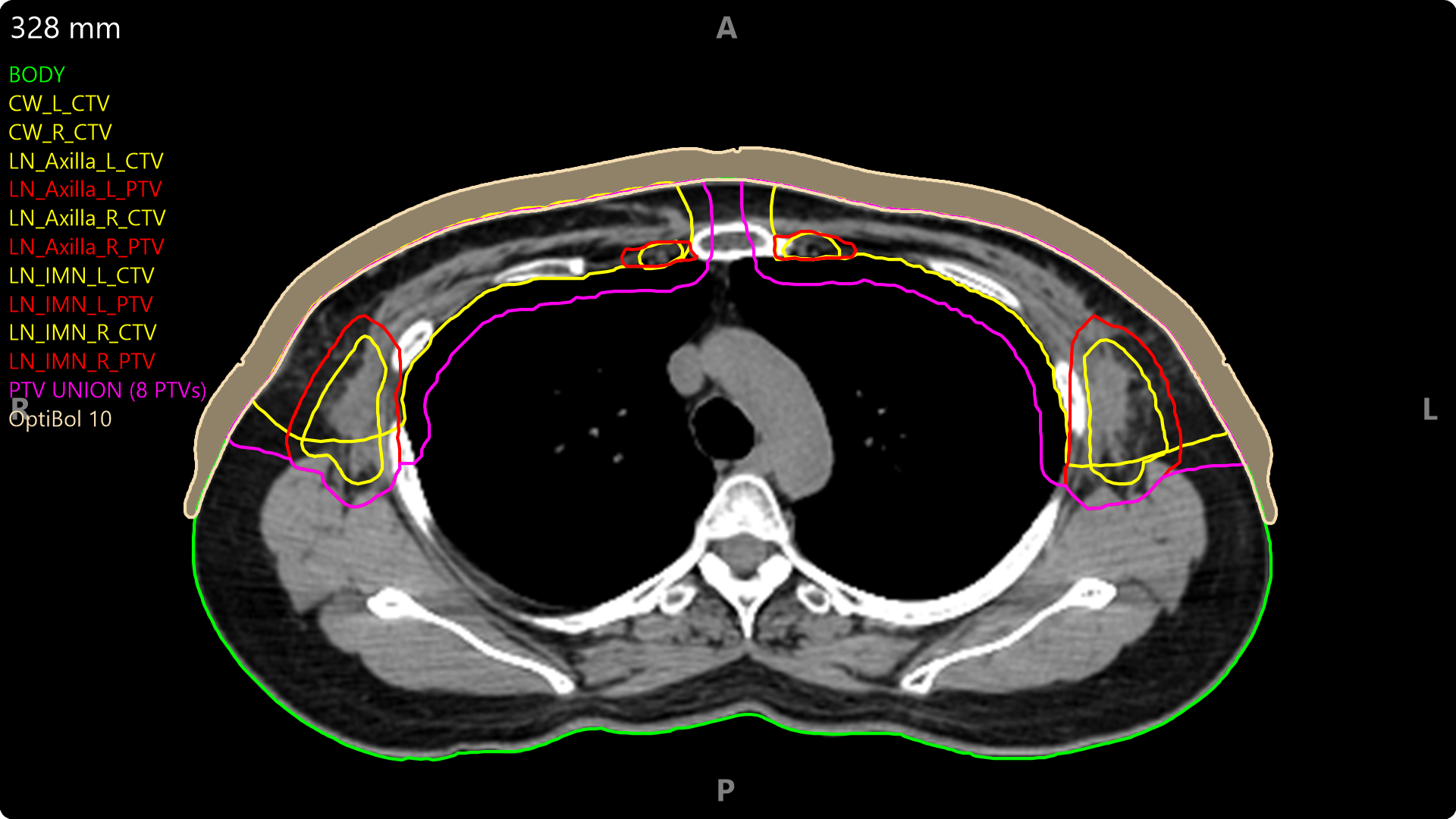
- An axial slice showing a target-based, variable-thickness bolus designed to provide 10 mm minimum buildup to underlying PTV. Due to the target abutting the patient surface, large portions of the bolus are 10 mm thick and uniform, with tapering at the edges. Alignment guides are added as very small variations in thickness along sagittal and coronal planes.
- 3D bolus design as seen in the p.d software.
- Depth-volume histograms for the voxels in the underlying PTV shown with no bolus vs. OptiBol 10 mm
Details on Depth-Volume Histograms (Gallery Item 3)
Variable-Thickness OptiBol (Goal 10 mm to Target)
- 99.2% of the target voxels have min depth ≥ 10.0 mm (0.8% < 10 mm)
- 99.8% of the target voxels have min depth ≥ 9.5 mm (0.2% < 9.5 mm)
No Bolus
- Only 69% of the target voxels have min depth ≥ 10 mm (31% target < 10 mm)
- Only 70% of the target voxels have min depth ≥ 9.5 mm (30% < 9.5 mm)