

Head / Neck Adaptive
Gallery: Head/Neck Adaptive Example
Summary
This is the dataset used in the AAMD 2023 Plan Study and publicly available via the ProKnow Quality Systems website.
This patient is a head/neck patient where a bolus might not conventionally be considered because of practical considerations (e.g., bolus wrapping around to the posterior of the patient).
However, a considerable portion of the target voxels are shallow enough to warrant considering bolus. OptiBol custom-fit boluses could improve target coverage for such patients if the immobilization / posterior bolus support challenges could be addressed.
Gallery
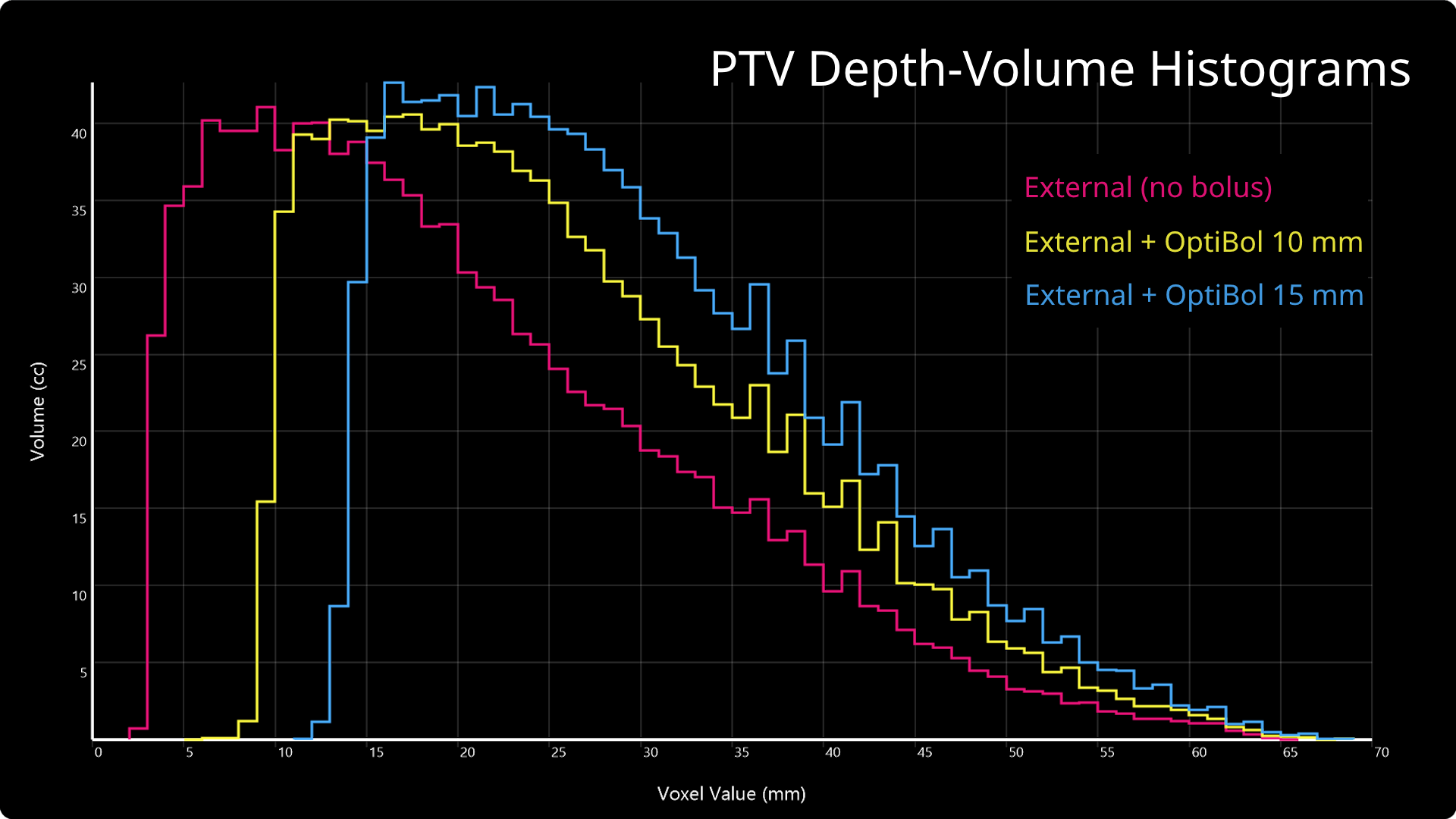
- Depth-volume histograms showing the minimum depth of target voxels (union over all PTVs) for the case of no bolus as well as for two variable-thickness bolus designs with 10 mm and 15 mm buildup (respectively) to the underlying target
- 3D display in the p.d software of the OptiBol with 15 mm goal buildup
- Axial planes showing no bolus, OptiBol 10 mm, and OptiBol 15 mm
Details on Depth-Volume Histograms (Gallery Item 2)
Variable-Thickness OptiBol (Goal 15 mm to Target)
- 100% of the target voxels have min depth ≥ 10 mm (0% target < 10 mm)
- 96.4% of the target voxels have min depth ≥ 15 mm (3.6% target < 15 mm)
Variable-Thickness OptiBol (Goal 10 mm to Target)
- 98.5% of the target voxels have min depth ≥ 10 mm (1.5% target < 10 mm)
- 81.3% of the target voxels have min depth ≥ 15 mm (18.7% target < 15 mm)
No Bolus
- Only 77.3% of the target voxels have min depth ≥ 10 mm (22.7% target < 10 mm)
- Only 59.9% of the target voxels have min depth ≥ 15 mm (40.1% target < 15 mm)